Corporate event games: 8 formats that drive participation

Choosing the right corporate event games determines whether your attendees participate or disengage. Most events lose the room well before the agenda ends, and the format is usually the reason. When an event gives attendees something to compete for, participation rates change and so does what people remember about the experience. These eight formats are the ones corporate event planners and HR teams return to, because each one creates a different type of competitive moment depending on what the event needs to achieve.
Key Highlights
- Live Trivia with speed-and-accuracy scoring consistently generates the highest simultaneous participation of any corporate event game format, with real-time leaderboard updates keeping energy elevated throughout the session.
- Tombola and Raffle are the most accessible entry points for corporate events because they require zero skill and zero preparation from participants, making them the right choice for mixed-seniority or large-group settings.
- Daily Puzzle is built specifically for habit formation across multiple days, making it the strongest mechanic for week-long programs where daily return visits are the goal.
- Survey and Poll formats are consistently underestimated as engagement tools: deployed competitively with live visible results, they generate higher response rates than standalone feedback tools.
Why the right corporate event games determine whether an event lands
The most common corporate event mistake is treating engagement as decoration rather than structure. A game bolted onto the end of an agenda generates polite participation. A game format built into the event's competitive logic generates the kind of participation people talk about afterward.
Each of the eight formats below produces a different behavioral outcome. Some create a single high-energy moment. Others build a habit loop across days. Some work best for 30 people in a room. Others scale to thousands simultaneously. Choosing the wrong format for the context is the fastest way to turn an interactive concept into an awkward pause.
The format is not the entertainment. It is the mechanic that determines what your attendees do, how often they come back, and what data the experience generates.
The 8 interactive games for corporate events
At a glance, these corporate event games split into two groups: single-moment formats that create a peak of participation at a defined time, and sustained formats that build engagement across hours or days. Knowing which group fits your event duration is the first decision to make.
| Format | Best for | Participation style | Why it works |
|---|---|---|---|
| Live Trivia | Conferences & kick-offs | Real-time | Competitive live leaderboard |
| Tombola | Large mixed groups | Passive participation | Zero skill barrier |
| Tournament | Team competitions | Bracket-based | Sustained competitive tension |
| Custom Leaderboard | Multi-day events | Async | Continuous visible ranking |
| Wheel | Booths & activations | Instant reward | Fast energy boost |
| Raffle | Long-form engagement | Action-based | Rewards participation over time |
| Daily Puzzle | Multi-day programs | Habit loop | Drives repeat return visits |
| Survey & Poll | Town halls & feedback | Live interaction | Real-time audience comparison |
Single-moment formats
These four formats are designed for a defined activation window. They peak fast, generate high energy in a short period, and work well as standalone sessions or as the closing moment of a longer event.
Live Trivia
Participants answer questions simultaneously, rankings update after every question, and the competitive pressure builds in real time. Scoring runs on speed and accuracy combined, which rewards both knowledge and responsiveness.
- Best for: Conference sessions, town halls, product launches, annual kick-offs
- Participation style: Synchronous, real-time
- Why it works: The leaderboard is live and visible throughout, so every question raises the stakes for everyone in the room simultaneously
Tombola
Numbers are drawn, tickets are matched, and someone wins. There is no skill component and no preparation required from participants, which makes the format inclusive regardless of role or seniority.
- Best for: End-of-event prize draws, appreciation events, large mixed-audience gatherings
- Participation style: Passive, chance-based
- Why it works: Equal access and universal anticipation make it the highest-inclusion format in the toolkit. Works well layered on top of Trivia: earn tickets by answering questions, redeem them in the Tombola draw
Wheel
A participant spins, lands on a prize tier, and either wins immediately or adds to their prize pool. The mechanic is fast, visual, and requires almost no cognitive load.
- Best for: Physical event stands, conference activations, onboarding moments, loyalty milestone rewards
- Participation style: Instant, individual
- Why it works: Resets the energy in the room without requiring a full session. Effective as a transition mechanic between heavier formats
Survey & Poll
When results update in real time and the display is visible to the whole room, the dynamic shifts from passive feedback to active participation. People vote to see how their view compares to everyone else's, not just to submit an opinion.
- Best for: Town halls, product feedback sessions, strategic alignment events
- Participation style: Live, interactive
- Why it works: Deploying competitively with live result displays generates response rates that passive feedback tools consistently fail to match
Sustained formats
These four formats are built for engagement that runs across a defined period. They work best when there is a competitive arc to follow, not just a single activation moment.
Tournament
Participants are matched head-to-head, winners advance, and the bracket updates automatically. Every match matters because losing means elimination and winning means progression toward a final.
- Best for: Department challenges, multi-day internal competitions, conference activations with a competitive storyline
- Participation style: Bracket-based, structured
- Why it works: The format creates sustained tension across the full event period. Tournament Hub supports both GUUL game titles and sports or esports categories, so the game can be adapted to the audience
Custom Leaderboard
You define the scoring criteria, the time window, and the ranking logic. Participants accumulate points through whatever behaviors the event is designed to incentivize: sessions attended, demos visited, challenges completed.
- Best for: Multi-track conferences, multi-day programs with multiple engagement touchpoints
- Participation style: Async, always-on
- Why it works: The leaderboard runs continuously without requiring a scheduled activation moment, so the competitive dynamic is present throughout the full event
Raffle
Participants earn entries by completing specific actions across the event period. The draw moment at the end becomes the payoff for sustained participation, not just a standalone prize activity.
- Best for: Events where you want to incentivize specific behaviors over a longer timeframe
- Participation style: Action-based, cumulative
- Why it works: Tying entries to behaviors turns the prize draw into a performance mechanic rather than a chance mechanic. Participants who engaged more have more to gain
Daily Puzzle
Participants complete a short puzzle each day, receive a score, and rank against everyone else who played that day. The solo experience feels social because of the shared leaderboard, and the streak mechanic creates a reason to return every day.
- Best for: Multi-day conferences, week-long internal engagement programs, seasonal campaigns
- Participation style: Async, habit-driven
- Why it works: The streak mechanic creates a pull that other formats cannot replicate: a user who played yesterday has a reason to return today that has nothing to do with prizes
How GUUL deploys these formats for corporate events
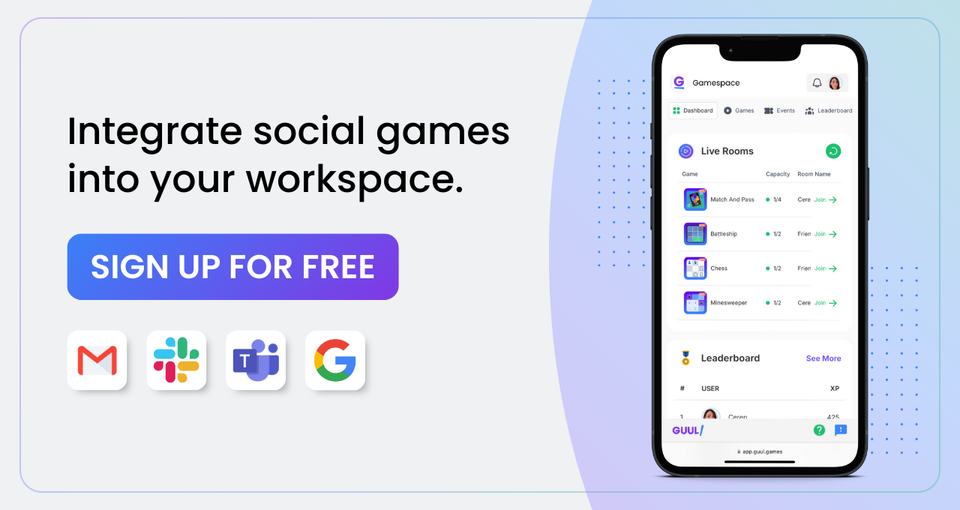
All eight formats are available as self-serve event types within GUUL's Gamespace platform, making it one of the few corporate event planning tools that covers both single-moment and sustained engagement formats in one place. Each is configurable without technical involvement: an administrator creates the event, sets the format parameters, defines the prize structure, and launches. Participants access the experience through a web-based environment that integrates with the tools and platforms a business already uses, with no additional account setup required.
Events run on GET, GUUL's credit-based system where every format is priced by type and participant capacity. Costs are predictable before a single event goes live, and GET packages scale with volume.
For events that need a fully branded, self-contained environment rather than an always-on platform integration, GUUL builds a custom branded gaming experience scoped to the specific event: its own domain, its own visual identity, its own game selection, and its own competitive structure. At Brandweek İstanbul, a healthcare brand activated this model during their conference session. Attendees scanned a QR code, entered a fully branded 120-second word game built around health and wellness vocabulary, and competed on a live leaderboard in real time. 35% of session attendees actively participated, turning a passive presentation moment into a competitive, high-energy experience.
The eight formats are not mutually exclusive. A conference might run Live Trivia as the main session event, layer a Custom Leaderboard across the full day, and close with a Tombola draw. A week-long program might run a different game format each day, with a cumulative leaderboard tracking performance across the full period. The format combination determines the engagement arc, not any single mechanic in isolation.
What to consider when choosing a format
The right format depends on four variables: audience size, event duration, participation mode, and the outcome you are measuring.
Audience size affects which formats scale cleanly. Live Trivia, Tombola, Wheel, and Raffle work for audiences of any size. Tournament and Custom Leaderboard perform best with enough participants to generate meaningful competition. Daily Puzzle works at any size but requires enough players for the leaderboard to feel social.
Event duration is the most important variable. Single-moment formats peak and close. Sustained formats need time to build. If your event runs for more than one day, at least one sustained format should be in the mix.
Participation mode matters for remote and hybrid events. Whether you are looking for virtual corporate event ideas or planning an in-person activation, all eight formats work online. For in-person activations, Wheel and Tombola have a physical and visual dimension that adds to room energy in a way async formats do not replicate.
The outcome you want to measure shapes every other decision. If the goal is participation rate, Tombola and Trivia deliver the most accessible entry. If the goal is repeat behavior, Daily Puzzle and Raffle create the strongest loop. If the goal is behavioral insight from the audience, Survey and Poll generate the most structured data.
Key Takeaways
- Decide first whether your event needs a single-moment format or a sustained format. This one decision eliminates half the options and makes every other choice easier.
- Layer formats rather than choosing just one. A Tombola draw at the end of a Trivia session creates a two-stage engagement arc that outperforms either format used alone.
- For mixed-seniority or large mixed-audience events, start with Tombola or Wheel before introducing competitive scoring formats. Lowering the participation barrier first increases overall engagement when the competitive formats launch.
- Survey and Poll are worth reconsidering as engagement formats rather than feedback tools. Deploying them with live visible results during a session changes how people participate in them.
- For events that need a fully branded environment rather than a platform integration, a custom branded gaming experience scoped to the event brief gives you all eight formats inside a dedicated space with its own identity and access logic.
Frequently Asked Questions
What types of games work best for online corporate events?
The formats that consistently perform best for online corporate events are Live Trivia, Daily Puzzle, and Tournament, because each one creates a competitive dynamic that works without physical presence. Live Trivia generates a synchronous high-energy moment. Daily Puzzle sustains participation across multiple days. Tournament creates a structured competitive narrative that runs across a defined period. The right choice depends on whether you need a single peak moment or sustained engagement over time.
How do you run a corporate event game for a large remote team?
Live Trivia and Tombola are the most scalable formats for large remote teams because they require no prior skill and no coordination beyond a shared start time. GUUL's Gamespace supports simultaneous participation through a web-based environment that requires no additional setup from participants. For teams spread across time zones, Custom Leaderboard and Daily Puzzle work better because participation is asynchronous.
What is the difference between a Raffle and a Tombola in a corporate event?
A Tombola distributes tickets equally to all participants, making it a pure chance mechanic with no skill or behavior component. A Raffle ties ticket acquisition to specific actions: attending a session, completing a challenge, or hitting a participation milestone. Use Tombola when you want equal access regardless of engagement level. Use Raffle when you want to reward specific behaviors across an event period.
How much does it cost to run a corporate event game?
Pricing depends on the format and participant capacity. GUUL's events run on GET, a credit-based system where each format is priced by type and the number of participants. GET packages are available at different volumes, with discounts on larger purchases. For a quote based on your event size and format, contact the GUUL team directly.
What is the easiest corporate event game to run for a large group?
Tombola and Live Trivia are the lowest-friction formats for large groups. Tombola requires no skill and no preparation from participants — attendance alone qualifies them to participate. Live Trivia requires only a shared start time and an internet connection. Both formats scale to any audience size and can be launched with minimal lead time through GUUL's Gamespace platform.
See how GUUL's event formats work for corporate activations →