Google Meet games: how to add play to your calls
There is a reason people groan when they see another Google Meet invite. It is not that the tool does not work. It is that video calls are cognitively expensive in ways that in-person meetings are not, and most of us are doing far too many of them.
Stanford professor Jeremy Bailenson's research, which studied 10,591 participants and established the Zoom Exhaustion and Fatigue Scale, identified four mechanisms that make video calls uniquely draining: the intense close-up eye contact that mimics confrontational gaze, the cognitive load of actively managing nonverbal cues that happen automatically in person, physical immobility from being fixed to a camera frame, and the constant self-view that does not exist in face-to-face conversation. None of these are solved by a better agenda or a sharper background.
Google Meet games address a different problem: not how to make meetings more efficient, but how to give participants a genuine moment of active, social engagement that breaks the cognitive pattern without requiring anyone to leave the call.
Key highlights
- Stanford's Zoom Exhaustion and Fatigue research, based on 10,591 participants, found that daily video conferencing usage directly predicts fatigue levels, with four specific nonverbal mechanisms identified as the primary causes.
- Google Meet has over 300 million monthly active users, and Google Workspace as a whole serves over 3 billion active monthly users and 11 million paying business customers as of Q4 2025, according to Alphabet's earnings report.
- The most effective Google Meet games are formats that take under ten minutes, require no separate account or download, and give all participants an active role rather than a passive one.
- Games used as meeting warm-ups consistently increase subsequent participation quality. A five-minute trivia round before a brainstorm changes the conversational energy for the session that follows.
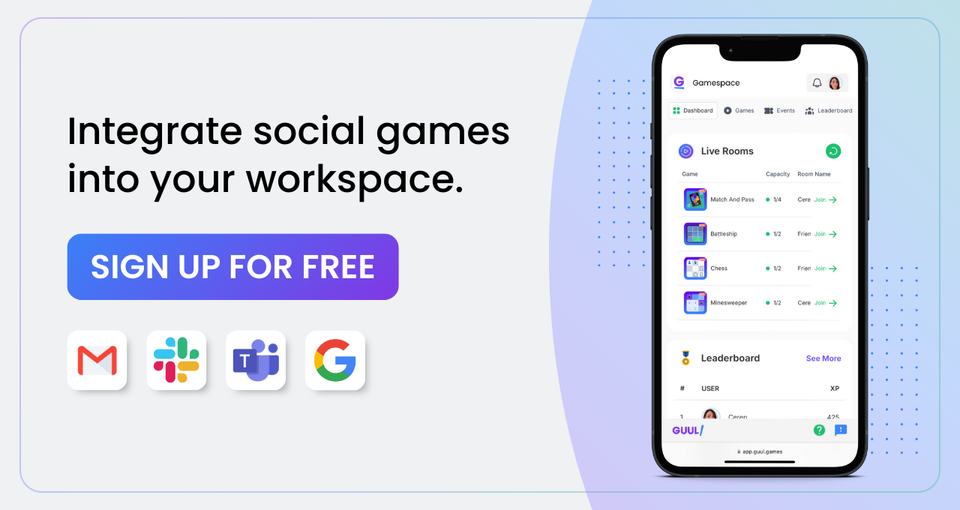
- For Google Workspace users, GUUL Gamespace is accessible at app.guul.games by signing in with an existing Google account. No new account, no new platform, no friction.
Why video call fatigue is a design problem, not a willpower problem
Meeting fatigue is not what happens when people are not trying hard enough. It is what happens when a communication format demands more cognitive resources than it replenishes. Bailenson's research is specific about the mechanisms: video calls require conscious management of behaviors that face-to-face communication handles automatically. You have to actively think about whether your nod was visible, whether your thumbs-up conveyed what a natural smile would, whether your camera angle is making you look engaged.
In-person meetings let your brain manage nonverbal communication in the background. Video calls move it to the foreground. That is not a small thing, repeated across eight calls a day.
The consequence of this chronic cognitive load is not just tiredness. Research published in Nature found that virtual meetings reduced the brain synchrony associated with creative idea generation compared to in-person interaction. A 2022 study by Brucks and Levav found that virtual meetings actively constrained creative thinking by narrowing visual and social focus.
The practical implication for teams is that back-to-back Google Meet calls do not just tire people out. They reduce the quality of the thinking happening in those calls. A five-minute game that shifts the cognitive mode, from passive reception to active engagement, is not a distraction from the meeting's purpose. It is a reset that improves the quality of what follows.
How games for Google Meet work: the side panel approach
GUUL runs as a native add-on inside Google Meet. Once installed from the Google Workspace Marketplace, the add-on appears in the side panel of every Google Meet session. The host opens the GUUL panel, selects a game, and participants join directly within the meeting, without leaving the call, opening a separate tab, or creating a new account.
Sign-in uses existing Google credentials. There is no separate account creation, no new platform to navigate, and no context switch. The game is in the meeting, in the panel, available in seconds.
No new tool. No new login. The game opens in the side panel of the call they are already in.
For Google Meet games that work as meeting openers or warm-ups, this setup takes under two minutes to initiate from the first session. For teams running regular game sessions, GUUL remains installed and accessible in the panel for every subsequent meeting automatically.
The GUUL web app at app.guul.games also provides access to Gamespace outside of active calls, including daily puzzles with shared leaderboards, XP tracking, and the event calendar, all accessible with Google sign-in for ongoing team engagement between meetings.
Google Meet game formats: what to use when
The formats that work in Google Meet fall into two categories. Synchronous formats run during the call with all participants active simultaneously. Asynchronous formats run between calls and create ongoing engagement that the meeting later references.
| Format | When it works | Session length | Primary benefit |
|---|---|---|---|
| Live Trivia | Meeting warm-up, all-hands opener | 5-15 min | Energy reset, shared moment |
| Daily puzzle (shared leaderboard) | Between meetings, referenced in call | 5 min async | Daily habit, social comparison |
| Prediction game | Before a live event or milestone | 2 min entry | Anticipation, shared stakes |
| Quick multiplayer game (Chess, Scrabble) | Between two call participants before/after | 10-20 min | Peer relationship, banter |
| Tournament bracket | Ongoing across team | Multi-day | Competitive arc, something to talk about |
| Tombola or raffle | Team celebration or milestone | 5 min | Variable reward, collective moment |
The meeting warm-up is the highest-impact deployment. A five-minute live trivia round at the start of a call does three things: it activates participants who were in passive mode, it creates a shared conversational opening that is not work-related, and it gives the host a natural transition into the meeting agenda. The energy difference between a meeting that starts with "let's dive in" and one that starts with a quick game is consistently reported by teams who have tried both.
Fun online games to play on Google Meet by use case
Every game online Google Meet participants can access runs directly from the GUUL side panel. Here is which format fits which moment:
For all-hands and large team meetings: Live Trivia with questions on a mix of company knowledge and general topics. The format scales to any team size, works with participants whose cameras are off, and requires no prior gaming experience. A host running the trivia from the Gamespace dashboard displays questions and results in real time while sharing their screen.
For smaller team meetings and team rituals: A daily puzzle score comparison. Each team member completes the daily word game before the call and shares their score in the meeting chat. The call opens with a quick "who got it in two?" The game happened before the meeting. The meeting creates the social moment around it.
For cross-functional meetings: A prediction game tied to something both teams care about: an upcoming product launch result, a campaign performance outcome, a sporting event that the office is already talking about. Both teams enter predictions before the call. The call opens by reviewing who predicted what and why.
For onboarding calls: A paired quick game between the new hire and their buddy or manager before the first formal meeting. Chess, Scrabble, or Connect4 over a five-minute call creates a shared memory and a natural follow-up conversation that an introductory meeting cannot replicate.
For celebration calls: A tombola or raffle draw during the team celebration meeting. Participants are entered based on contributions during the quarter, and results draw live on screen. The variable reward mechanic produces more energy than a fixed recognition announcement.
For long calls and workshops: A five-minute game break at the 45-minute mark of any call longer than an hour. Albulescu et al.'s meta-analysis of 22 micro-break studies found that short non-work breaks significantly reduce fatigue and increase vigor. A game break accomplishes this while maintaining the social cohesion of the group, rather than dispersing people to individual screen breaks.
How to get started with GUUL on Google Meet
GUUL is available on the Google Workspace Marketplace. Installation is straightforward:
- Find GUUL Gamespace on the Google Workspace Marketplace and install it to your workspace
- Open a new or scheduled Google Meet session
- Open the GUUL add-on from the side panel, choose a game, and start playing
Once installed, GUUL appears in the side panel of every Google Meet session for all users in the workspace. Sign-in uses existing Google credentials. No separate account creation is needed.
For organization-wide deployment and admin management, the Workspace Marketplace installation allows admins to manage access through the standard Google Workspace admin console. The Gamespace Scheduler allows team leads and HR managers to plan a calendar of game events in advance, a weekly trivia opener, a monthly team tournament, a quarterly prediction challenge, which participants access directly from the side panel in their next Meet session.
What to measure
Whether Google Meet games are working is visible in both qualitative and quantitative signals.
Participation rate in game sessions shows whether the format is accessible enough to reach everyone, not just the most socially active participants. A game format that only the usual contributors engage with has not solved the passivity problem.
Meeting energy and contribution quality in the calls that follow game warm-ups compared to those without. This is qualitative but consistent: teams that run game warm-ups report higher participation, more off-topic conversation (a sign of psychological safety), and stronger ideas generation in the sessions that follow.
Return participation measures whether game participants come back voluntarily for the next session. Recurring participation in an optional game ritual is one of the clearest signals that the format is producing genuine value rather than novelty engagement.
Key takeaways
- Video call fatigue is a cognitive load problem, not a motivation problem. Stanford's research identifies four specific mechanisms. Games address this by shifting the cognitive mode from passive reception to active engagement.
- Google Meet games work best when they are integrated into the call rhythm rather than added as a separate event. A five-minute trivia warm-up before a brainstorm changes the quality of the brainstorm.
- For Google Workspace users, GUUL requires no new account, no new tool, and no context switch. Sign in with Google at app.guul.games and the game is accessible within seconds.
- The formats that produce the most sustained engagement are those that create ongoing rituals: a daily puzzle that the team compares during stand-up, a weekly trivia opener, a quarterly prediction tournament. One-off game sessions produce novelty. Recurring formats produce culture.
- Measure participation rate, meeting contribution quality in sessions following game warm-ups, and return participation rate. These three signals tell you whether the games are producing the team connection outcomes they were designed for.
FAQ
What are Google Meet games? Google Meet games are playable formats used during or around Google Meet calls to increase active participation, reduce meeting fatigue, and build team connection. They range from live trivia rounds run as meeting warm-ups to daily puzzles that teams compare during their stand-up call to tournament brackets that run across a team over several weeks. For Google Workspace users, GUUL provides game access at app.guul.games with Google sign-in, with no additional accounts or platform setup required.
How do you play games on Google Meet? The simplest approach is to share a game link in the meeting chat during the call. Participants open the link in a new tab and play while remaining in the Google Meet session. For screen-share formats like live trivia, the host runs the game from the Gamespace dashboard and shares their screen so all participants see the questions and results simultaneously. For games that run between meetings, the host shares the link in the team chat or includes it in the calendar invite.
What fun online games can you play on Google Meet with your team? Live trivia works best for all-hands and large team calls. Daily puzzles with shared leaderboards work best as between-meeting rituals referenced during stand-up. Paired games like Chess or Scrabble work best for relationship-building between two colleagues before or after a call. Prediction games work best tied to live events or milestones. Tombola and raffle formats work best for team celebration moments. Tournament brackets work best as multi-day competitive events that give the team something ongoing to reference during calls.
Why do games reduce meeting fatigue? Stanford's research identifies video conferencing cognitive load as one of four primary causes of meeting fatigue: managing nonverbal cues consciously requires significantly more mental effort than the automatic nonverbal processing that happens in person. Games provide a pattern interrupt that shifts this load, moving participants from passive reception to active engagement. Albulescu et al.'s meta-analysis of micro-break research found that short non-work activity breaks significantly reduce fatigue and increase vigor, with the effect present even in five-minute windows.
How does GUUL work with Google Meet? GUUL runs as a native add-on inside Google Meet, installed from the Google Workspace Marketplace. Once installed, it appears in the side panel of every Google Meet session. The host opens the GUUL panel, selects a game, and participants join directly within the meeting without leaving the call or creating a new account. Sign-in uses existing Google credentials. Outside of active meetings, the GUUL web app at app.guul.games provides access to Gamespace, daily puzzles, leaderboards, and the event calendar, all accessible with Google sign-in.
Get GUUL on Google Workspace Marketplace →
Sources
- Bailenson, J.N. (2021). Nonverbal overload: A theoretical argument for the causes of Zoom fatigue. Technology, Mind, and Behavior, 2(1). https://news.stanford.edu/stories/2021/02/four-causes-zoom-fatigue-solutions
- Fauville, G. et al. (2021). Zoom Exhaustion and Fatigue Scale. 10,591 participants. SSRN. https://ssrn.com/abstract=3820035
- Brucks, M.S. and Levav, J. (2022). Virtual communication curbs creative idea generation. Nature, 605, 108-112.
- Albulescu, P. et al. (2022). "Give me a break!" Meta-analysis of micro-breaks, 22 studies. PLOS ONE. https://journals.plos.org/plosone/article?id=10.1371/journal.pone.0272460
- AboutChromebooks (2026). Google Workspace Integration and Usage Statistics 2026. 3 billion MAU, 11 million paying customers Q4 2025. https://www.aboutchromebooks.com/google-workspace-integration-usage-rates/
- EarthWeb (2026). How Many People Use Google Meet in 2026. 300 million monthly active users. https://earthweb.com/google-meet-users/
- Google Workspace Marketplace. GUUL Gamespace. https://workspace.google.com/marketplace/app/guul_gamespace/198395429941