Multiplayer online games that bring people together
Multiplayer online games do something that most community-building tools cannot: they create a shared competitive moment that people genuinely want to return to. A leaderboard that updates in real time, a match that hangs on a single move, a word that scores higher than anyone expected. These are the moments that turn a group of people into a community. This list covers ten multiplayer online games that work precisely because of their competitive dynamics, with practical guidance on which format fits which group size and context.
Key Highlights
- Multiplayer online games are one of the most effective community building activities because they create shared competitive experiences that generate conversation, rivalry, and recurring participation.
- The best multiplayer games for groups are those with a low learning curve but a high skill ceiling: easy enough for anyone to join, deep enough to keep experienced players engaged.
- Game session length matters as much as game type when choosing a multiplayer format for a community or team. A two-minute quick game and a forty-minute strategy match serve different social functions.
- Online multiplayer games played inside existing platforms like Slack, Microsoft Teams, and Google Meet generate higher participation than games that require switching to a separate application.
- Variety across game types (strategy, word, card, and tactical) keeps community engagement sustained over time, because different members gravitate toward different formats.
Why multiplayer online games build stronger communities
A community that only interacts around information, announcements, and tasks develops a transactional relationship. Members show up when they need something and disappear when they do not. What changes this dynamic is shared experience: moments where members are doing something together rather than receiving something separately.
Multiplayer online games create these moments reliably. When two members play a game of Chess, they develop a competitive relationship that exists independently of any other reason they might be in the same community. When a group plays Boggle together, they share a result, a ranking, and a story. These micro-relationships accumulate into the social fabric that makes a community feel worth participating in rather than just worth monitoring.
For online communities specifically, whether they are brand communities, gaming groups, remote friend networks, or professional Slack workspaces, the absence of shared physical space makes this even more important. Multiplayer games online provide the kind of spontaneous competitive interaction that would happen naturally in a shared physical space but requires deliberate design in a digital one.
Community building activities that involve competition also generate something passive activities cannot: a reason to return. The player who lost a Scrabble game has a reason to challenge the winner again. The person who came third on the Boggle leaderboard has a reason to play again tomorrow. This return mechanic is what separates a one-time community activity from an ongoing community dynamic.
The 10 best multiplayer online games
These ten games cover the full range of competitive dynamics: pure strategy, word-based skill, card game tactics, and quick tactical formats. Each one is playable directly through GUUL across Slack, Microsoft Teams, and Google Meet.
| Game | Players | Type | Session length |
|---|---|---|---|
| Scrabble | Up to 4 | Word strategy | 20-40 min |
| Boggle | Up to 8 | Word speed | 5-10 min |
| Chess | 2 | Strategy | 15-45 min |
| Backgammon | 2 | Strategy + luck | 15-30 min |
| Match & Pass (UNO) | Up to 4 | Card | 15-25 min |
| Spades & Hearts | Up to 4 | Card strategy | 20-40 min |
| Battleship | 2 | Tactical | 10-20 min |
| Connect4 | 2 | Tactical | 5-10 min |
| Checkers & Draughts | 2 | Strategy | 10-20 min |
| Minesweeper | 2 | Puzzle + tactics | 5-15 min |
Scrabble
Scrabble is the definitive word strategy game and one of the most socially rich multiplayer formats available. Up to four players take turns placing letter tiles on a board, scoring points based on the letters used and their position. The game rewards vocabulary, spatial thinking, and the ability to find unexpected words in a constrained set of letters.
What makes Scrabble particularly effective as a community game is the conversation it generates. A high-scoring play, a challenged word, or a missed opportunity that someone else exploits all become talking points that extend beyond the game itself.
- Players: Up to 4
- Session length: 20-40 minutes
- Why it builds community: Every game produces memorable moments, and the mixed skill dynamic means experienced and casual players can compete meaningfully at the same table
Boggle
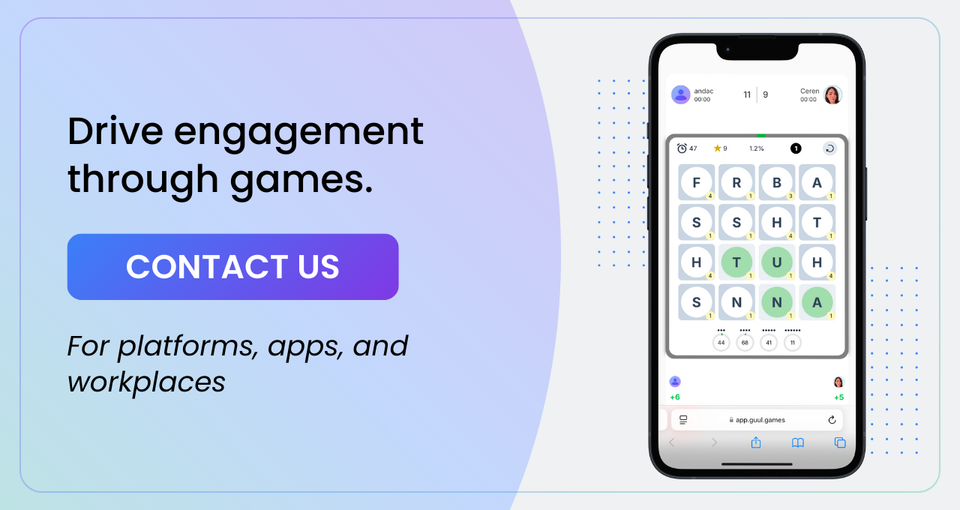
Boggle is the fastest multiplayer word game in the library and the best format for large groups. All players search the same grid of letters simultaneously, racing to find as many words as possible before the timer runs out. Longer and less obvious words score higher, which creates a dual competition: speed against all players and vocabulary depth against the leaderboard.
With up to eight players competing at once, Boggle generates the kind of simultaneous shared experience that most multiplayer games cannot achieve at that group size. Everyone is playing at the same time, and results are revealed together.
- Players: Up to 8
- Session length: 5-10 minutes
- Why it builds community: The simultaneous format means every player is in the same moment, which creates immediate shared reactions and a natural leaderboard conversation
Chess
Chess is the highest-skill-ceiling game in the library and the format that creates the most durable competitive relationships. Two players compete across a board of 64 squares, each managing 16 pieces with distinct movement rules. A game can resolve in fifteen minutes or extend across an hour depending on the players' pace and style.
Chess is particularly effective for communities where ongoing rivalries matter. A series of Chess matches between two community members becomes a narrative, and that narrative creates engagement around results, rematches, and streaks.
- Players: 2
- Session length: 15-45 minutes
- Why it builds community: The depth of the game creates long-term rivalries and recurring matches that generate a competitive relationship independent of any other community activity
Backgammon
Backgammon combines strategy with the unpredictability of dice, which creates a different competitive dynamic than pure strategy games. Two players race their pieces around the board toward their home quadrant, with dice rolls introducing an element of chance that keeps both players engaged regardless of skill gap.
The combination of luck and strategy means a less experienced player can win a session against a stronger opponent, which makes the format more inclusive than Chess for mixed-skill communities.
- Players: 2
- Session length: 15-30 minutes
- Why it builds community: The luck element keeps outcomes unpredictable and makes every game worth playing regardless of the skill gap between players
Match & Pass (UNO)
Match & Pass is GUUL's UNO-style card game and the most universally familiar multiplayer format in the library. Players match cards by color or number, using action cards to skip turns, reverse play order, or force opponents to draw additional cards. The goal is to empty your hand first.
The familiarity of the format means zero explanation is needed. Any group can start playing immediately, and the action card mechanics create the kind of dramatic reversals that generate laughter and competitive energy simultaneously.
- Players: Up to 4
- Session length: 15-25 minutes
- Why it builds community: Universal familiarity removes the learning curve entirely; the action card mechanics create dramatic moments that become shared references within the group
Spades & Hearts
Spades and Hearts are trick-taking card games that reward partnership and strategic card management. In Spades, players bid on how many tricks they expect to win and must meet their bid to score positively. In Hearts, players avoid taking point cards while attempting to force them onto opponents.
Both formats reward long-term pattern recognition and develop a specific kind of competitive relationship: players learn each other's tendencies over multiple games, which makes the rivalry deepen with each session.
- Players: Up to 4
- Session length: 20-40 minutes
- Why it builds community: The bidding and partnership mechanics create strategic interdependence between players, which generates richer post-game discussion than luck-based formats
Battleship
Battleship is a hidden information game where two players take turns guessing the coordinates of each other's fleet. Neither player can see the opponent's board, which creates sustained tension throughout the game: every hit narrows the search, and every miss builds anticipation.
The hidden information mechanic makes Battleship uniquely engaging as a spectator game. When played inside a video call with screen sharing, the rest of the group can observe one player's board without the opponent seeing it, which creates a commentary dynamic that adds energy to the session.
- Players: 2
- Session length: 10-20 minutes
- Why it builds community: The hidden information creates collective tension that works both as a two-player game and as a spectator experience for larger groups
Connect4
Connect4 is the fastest competitive format in the library. Two players alternate dropping colored discs into a vertical grid, racing to connect four in a row horizontally, vertically, or diagonally. A game resolves in minutes, which makes it ideal for quick competitive moments between other activities.
The simplicity of the rules means anyone can learn Connect4 in thirty seconds, but the strategic depth of blocking and setting up multi-direction threats means experienced players have a clear advantage. This combination makes it one of the most accessible entry points for new community members.
- Players: 2
- Session length: 5-10 minutes
- Why it builds community: The speed of each game makes it easy to run a series of matches within a single session, which creates a quick competitive arc with a clear narrative
Checkers & Draughts
Checkers (also known as Draughts) is a diagonal movement strategy game where two players compete to capture all of the opponent's pieces or block them from making any legal moves. Pieces that reach the opposite end of the board are kinged and gain additional movement capabilities, which shifts the strategic balance as the game progresses.
Checkers occupies the middle ground between Connect4 and Chess in terms of session length and strategic depth, making it a useful format for communities that want a strategy game with a shorter time commitment than Chess.
- Players: 2
- Session length: 10-20 minutes
- Why it builds community: The piece capture mechanic creates visible momentum shifts that generate competitive tension and natural commentary throughout the game
Minesweeper
Minesweeper in its multiplayer format transforms the classic solo puzzle into a shared decision-making game. Two players work with the same board, each contributing moves to uncover safe squares and flag mines. The shared stakes create collective tension: a wrong decision affects both players simultaneously.
The puzzle-solving dynamic makes Minesweeper the most analytically engaging format in the library and appeals particularly to groups with a logical or problem-solving orientation.
- Players: 2
- Session length: 5-15 minutes
- Why it builds community: Shared decision-making under pressure creates a cooperative competitive experience where both players are fully invested in every move
How to choose the right game for your group
Three variables determine which multiplayer format fits your group: size, session length, and the competitive dynamic you want to create.
Group size is the first filter. For groups larger than four, Boggle is the only format that keeps all players active simultaneously. For groups of three or four, Scrabble, Match & Pass, and Spades & Hearts work well. For one-on-one competitive play, all ten games are available, and the choice comes down to session length and skill preference.
Session length shapes how games fit into a group's rhythm. Quick formats like Connect4, Boggle, and Minesweeper resolve in under ten minutes and work as openers or transitions between other activities. Mid-length formats like Battleship, Backgammon, and Checkers provide a more complete competitive arc without requiring a large time commitment. Longer formats like Scrabble, Chess, and Spades & Hearts work best as dedicated sessions rather than quick fillers.
Competitive dynamic is the most nuanced variable. Pure strategy games like Chess and Checkers reward skill consistently, which creates clear hierarchies within a community over time. Mixed-skill games like Backgammon and Match & Pass introduce luck elements that keep outcomes less predictable. Word games like Scrabble and Boggle reward vocabulary and lateral thinking, which surfaces different strengths within a group than strategy games do. Running multiple formats across a community calendar ensures that different members have opportunities to excel in different contexts.
How GUUL brings multiplayer games to your community
All ten games above are available through GUUL's platform across the tools communities already use. For Slack communities, games run directly inside channels with no additional application required. For Microsoft Teams workspaces, multiplayer social games are played with mics and cameras on during active meetings. For Google Meet, the full multiplayer library is accessible directly inside an active call, with the game board visible on the shared screen for all participants.
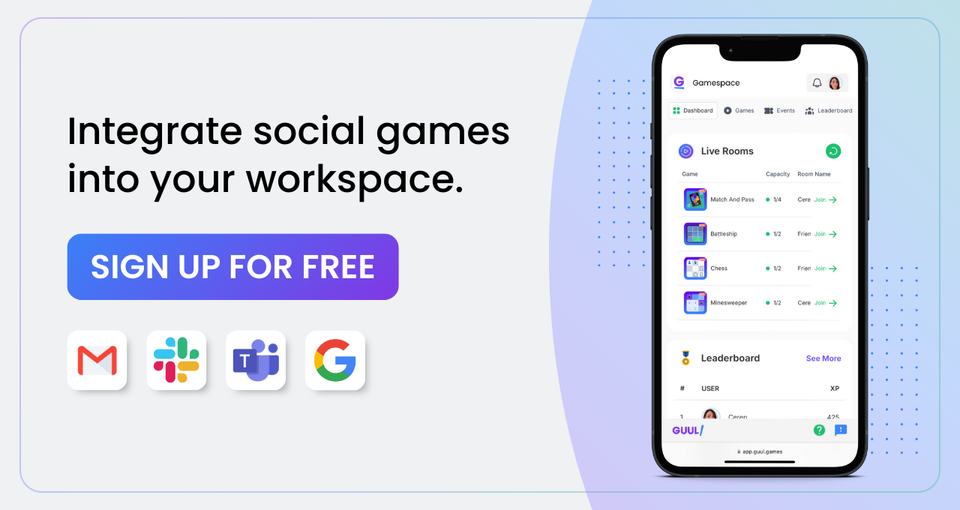
GUUL's Gamespace provides a permanent hub for communities that want a dedicated game environment beyond their existing communication tools. Members access a shared leaderboard, see active game rooms, and track their competitive history across all formats. For communities and brands that want a fully branded game environment, Gamespace can be configured with custom visuals, scoring logic, and reward structures.
For communities running events around multiplayer competition, GUUL's Tournament Hub manages the full bracket lifecycle: registration, matchmaking, fixture tracking, and live standings for any of the ten formats above.
Key Takeaways
- Start with Boggle or Match & Pass if your community has mixed experience levels. Both formats are immediately accessible and produce fast shared results that generate conversation.
- Use Chess or Backgammon to create ongoing competitive relationships within a community. The depth of both games means a single session is rarely the end of the story.
- Vary the format across sessions. A community that only plays one game type will eventually plateau in engagement. Rotating across word games, strategy games, and card games keeps different members at the forefront of the leaderboard at different times.
- For groups using Slack, Teams, or Google Meet, prioritize formats that run inside the existing platform. The lower the friction to join, the higher the participation rate.
- Use session length to match the game to the context. Quick formats work as community warm-ups or meeting openers. Longer formats work as dedicated competitive sessions or tournament formats.
Frequently Asked Questions
What are the best multiplayer online games to play with friends?
The best multiplayer online games depend on group size and how much time is available. For large groups of up to eight, Boggle provides simultaneous play that keeps everyone active at the same time. For groups of three or four, Scrabble and Match & Pass generate the strongest social dynamic. For head-to-head competition, Chess and Backgammon create the deepest competitive relationships over time. All of these are available through GUUL across Slack, Microsoft Teams, and Google Meet.
What multiplayer games can you play online without downloading anything?
All ten games in this list are playable directly through GUUL without downloading any additional application. For Slack and Microsoft Teams users, games run inside the platforms already in use. For Google Meet users, the full multiplayer library is accessible inside an active meeting. GUUL for Google Meet and GUUL for Teams are both available from their respective app marketplaces and install in minutes.
What are good multiplayer online games for community building?
The most effective multiplayer games for community building are those that create ongoing competitive relationships rather than one-off sessions. Chess and Backgammon build head-to-head rivalries over time. Scrabble and Boggle generate leaderboard competition that rewards different skills than strategy games. Running a mix of formats across a community calendar ensures that different members have opportunities to compete and connect in different contexts.
How many people can play multiplayer online games together?
It depends on the format. Boggle supports up to eight simultaneous players, making it the largest group format in GUUL's library. Scrabble, Match & Pass, and Spades & Hearts support up to four. Chess, Backgammon, Battleship, Connect4, Checkers, and Minesweeper are two-player formats. For larger groups, two-player games work well as spectator experiences: two players compete while the rest of the group watches and reacts, which is particularly effective inside a video call.