Virtual team building activities: 12 ideas for remote teams

Virtual team building activities are the difference between a remote team that functions and one that actually connects. When colleagues only interact through task-related messages and scheduled calls, the informal relationships that make teams resilient and collaborative never form. The right activity, whether a competitive game or a well-chosen icebreaker game for remote teams, creates a shared experience that carries over into how people work together the next day. These 12 ideas cover both competitive formats that drive engagement and social formats that build genuine connection, with guidance on which fits which team.
Key Highlights
- Remote teams that participate in regular virtual team building activities report higher collaboration scores and lower turnover than those that rely on work interactions alone.
- Competitive game-based activities generate the highest participation rates among virtual team building formats because they give employees a visible result to work toward.
- Social and creative activities build the informal relationships that competitive formats alone cannot create, making them a necessary complement rather than an alternative.
- The most effective virtual team building programs combine at least one recurring competitive format with one periodic social activity, creating both a habit loop and a memorable shared moment.
- Ice breakers for virtual meetings work best when they require minimal explanation and produce a visible, shareable outcome within the first five minutes of a session.
Why virtual team building activities matter for remote teams
Remote teams lose the informal interaction that happens naturally in a shared space. A conversation that starts in a kitchen, a comment overheard across a desk, a moment of spontaneous laughter before a meeting begins. None of these happen on a remote team without deliberate design.
Virtual team building activities replace that spontaneous interaction with structured moments that serve the same function. They give employees a reason to show up as people rather than job titles. Studies show that 73% of employees want more team building activities, and organizations that invest in regular virtual team building report measurable improvements in collaboration, communication, and retention.
The format matters as much as the frequency. Icebreaker games for remote teams work best when they are low-barrier and produce an immediate result. Competitive activities work best when they have a visible leaderboard and a recurring structure. Social activities work best when they are genuinely optional and create a shared reference point the team can return to. The 12 activities below are organized into two categories based on what outcome they are designed to produce.
At a glance: 12 virtual team building activities
| Activity | Category | Best for | Team size | Duration |
|---|---|---|---|---|
| Daily puzzle challenge | Competitive | Recurring engagement | Any | 5-10 min/day |
| Multiplayer board games | Competitive | Sustained competition | Any | 30-60 min |
| Live trivia night | Competitive | Scheduled activation | Any | 30-60 min |
| Predictor challenge | Competitive | Multi-week engagement | Any | Ongoing |
| Quick games tournament | Competitive | Spontaneous connection | Small-mid | 10-15 min |
| Virtual escape room | Social | Problem-solving | 4-10 | 60 min |
| Online cooking or cocktail class | Social | Relaxed bonding | Any | 60-90 min |
| Mystery chat | Social | Cross-team connection | Any | 15-20 min |
| Virtual talent show | Social | Celebrating team culture | Any | 45-60 min |
| DIY craft challenge | Social | Creative teams | Any | 30 min |
| Remote team bingo | Social | Low-effort icebreaker | Any | 10-15 min |
| ELI5 challenge | Social | Knowledge sharing | Any | 20-30 min |
Competitive and game-based activities
Competitive activities work because they give remote employees something concrete to engage with. A leaderboard to climb, a puzzle to solve faster than yesterday, a match to win. The result is visible and the motivation to return is built into the mechanic itself.
1. Daily puzzle challenge
A daily puzzle resets every day and gives every team member a reason to open a shared channel even when there is nothing work-related to respond to. Employees complete a short word or number puzzle, post their result, and rank against everyone else who played that day. The solo experience becomes social through the shared leaderboard.
Wordle-style word games work for mixed-skill teams because the format is immediately familiar. Number-based puzzles like Nerdle appeal to analytically oriented employees. Rotating the puzzle type across a competition period prevents the format from becoming repetitive.
- Best for: Distributed teams, always-on engagement, low-effort daily touchpoints
- Why it works: Resets daily so every employee starts fresh; streak mechanics add a second motivation layer on top of the daily ranking
GUUL's Find the Word and Nerdle formats run directly inside Slack and Microsoft Teams, with automatic leaderboard tracking and streak scoring that updates without any manual input from a manager.
2. Multiplayer board game session
Classic board games like Chess, Scrabble, Backgammon, and UNO translate directly to virtual settings without losing any of the competitive tension that makes them engaging. Players match head-to-head in real time, which creates the kind of focused, direct competition that passive activities cannot replicate.
The format works particularly well for remote teams because it requires no shared physical space, no logistics, and no preparation beyond starting a game. Two employees can decide to play a game of Scrabble between meetings and finish it in 30 minutes.
- Best for: Teams that enjoy strategy and word games, informal competitive sessions, cross-department connection
- Why it works: Real-time head-to-head competition creates a direct personal dynamic that is absent from most remote team interactions
GUUL's multiplayer game library includes Chess, Scrabble, Backgammon, UNO, Battleship, and more, all playable inside Slack and Microsoft Teams without leaving the platform.
3. Live trivia night
A live trivia night creates a synchronous high-energy moment where the whole team competes simultaneously. Questions are answered in real time, the leaderboard updates after each round, and the competitive pressure builds throughout the session. The format requires no preparation from participants and no prior knowledge of a specific topic.
Trivia works equally well as a standalone event or as the opening activity for a team meeting that needs energy. Questions can be tailored to company culture, industry knowledge, or a seasonal theme, which makes the format reusable across a full calendar year.
- Best for: All team sizes, scheduled activation moments, onboarding events, team off-sites
- Why it works: Zero barrier to entry combined with real-time leaderboard visibility keeps the energy high from the first question to the last
GUUL's Trivia format runs as a live event inside Gamespace, with speed-and-accuracy scoring that rewards both knowledge and response time.
4. Predictor challenge
A predictor challenge asks employees to submit predictions on real-world outcomes before they happen. Points accumulate based on accuracy as results come in, and the leaderboard evolves across the event window. The format borrows engagement from events employees already care about, which means it requires almost no promotion to generate participation.
A Champions League predictor, a Formula 1 season challenge, an Oscars prediction contest, or a company product launch vote all use the same mechanic. Employees in different time zones compete on equal terms because participation is fully asynchronous.
- Best for: Teams with shared interest in sports, culture, or industry events; multi-week engagement programs
- Why it works: The external event calendar sustains engagement across weeks without requiring any scheduled activation from the organizer
GUUL's Predictor format covers major sports events including the Champions League, Premier League, Formula 1, and the Olympics, as well as cultural moments like the Oscars.
5. Quick games tournament
Quick games are the spontaneous format. A team member launches a game in a shared channel, another joins, and a short match happens between meetings. No scheduling, no setup, no prize structure required. The competitive moment is self-contained and resolves in minutes.
Tic Tac Toe is the most accessible entry point because the rules require no explanation. Running a loose tournament bracket across a week, with results tracked on a shared leaderboard, turns a series of spontaneous games into a team-wide competition with a defined winner.
- Best for: High-activity channels, teams that need low-commitment ways to connect, spontaneous interaction between tasks
- Why it works: No coordination required means participation happens when employees have a spare moment, not only when a manager schedules it
GUUL's quick games including Tic Tac Toe run directly inside Slack and Microsoft Teams with a single command.
Social and creative activities
Social activities build the informal relationships that competitive formats alone cannot create. These seven activities do not require a platform, a leaderboard, or any technical setup. They require employees to show up as people, which is what remote teams need most.
6. Virtual escape room
A virtual escape room puts a small group of employees inside a timed puzzle challenge that requires collaboration to solve. Teams communicate under pressure, delegate tasks based on individual strengths, and experience the satisfaction of solving a problem together. The time constraint creates genuine urgency that most remote activities cannot replicate.
Escape rooms work best for groups of four to ten people. Larger groups can be split into competing teams running parallel sessions, with results compared at the end. The difficulty level should match the team's experience: a first-time escape room group benefits from a shorter, more accessible format.
- Best for: Established teams that want a challenge, problem-solving focused events, off-site activities
- Why it works: Collaborative pressure reveals how people think and communicate in ways that low-stakes activities do not
7. Online cooking or cocktail class
A hosted cooking or cocktail class gives remote employees a shared physical experience across different locations. Everyone receives the same ingredient list in advance, a host guides the session in real time, and the team ends up with something they made together even while physically apart.
The format works because it is genuinely relaxing. There is no performance pressure, no score, and no winner. Employees focus on the activity rather than on each other, which makes conversation easier and more natural. For teams that find structured social activities awkward, a cooking class removes the social pressure by giving everyone something to do with their hands.
- Best for: Teams that need a lower-pressure bonding moment, end-of-quarter celebrations, onboarding events for new hires
- Why it works: Shared physical activity across different locations creates a genuine parallel experience that purely digital activities cannot
8. Mystery chat
Mystery chat pairs employees anonymously for a short one-on-one conversation. Participants discuss a shared topic without knowing who their partner is, then guess each other's identity at the end. The anonymity removes the social hierarchy that often shapes remote interactions, creating more honest and equal conversations.
The format works particularly well for larger teams where employees in different departments rarely interact. A simple bot or manual pairing list is all the infrastructure required. Topics can be professional or entirely personal depending on the team's culture.
- Best for: Large teams, cross-department connection, breaking down seniority barriers
- Why it works: Anonymity creates equality in conversation; guessing the identity at the end turns a social exchange into a light competitive moment
9. Virtual talent show
A virtual talent show gives employees a space to share a skill, performance, or interest that has nothing to do with their job. Someone plays guitar for three minutes. Someone demonstrates a magic trick. Someone teaches a quick origami fold. The team reacts in real time.
The format works because it reveals the full person behind the job title. Remote teams that only interact around work tasks develop a narrow picture of their colleagues. A talent show changes that in a single session. Pre-recorded submissions work for employees who are uncomfortable performing live.
- Best for: Teams that have worked together for a while, culture-building moments, end-of-year events
- Why it works: Seeing colleagues outside their professional role builds the kind of personal connection that makes collaboration easier and more resilient
10. DIY craft challenge
A DIY craft challenge gives every employee 30 minutes to build or create something using only materials available at home. The brief can be open-ended or themed: build something that represents your week, create the most useful object you can find materials for, or make something that would survive a fall from a desk.
The time constraint creates urgency and the constraint of available materials creates creativity. Employees share results at the end of the 30 minutes, which generates the kind of spontaneous laughter and conversation that remote teams lose most in the absence of shared physical space.
- Best for: Creative teams, low-pressure bonding moments, team meetings that need an energizing opener
- Why it works: The constraint of available materials levels the playing field between employees with different creative backgrounds, and the result is always unexpected
11. Remote team bingo
Remote team bingo replaces generic bingo numbers with scenarios specific to remote work: "someone's camera froze," "dog appeared on screen," "someone said 'can you hear me' twice," "meeting could have been an email." Employees mark their cards as scenarios happen during a real meeting or across a week of remote work.
The format works because it turns the shared frustrations of remote work into a source of collective humor. It requires no setup beyond distributing a custom card and no dedicated time beyond the meetings the team already has scheduled.
- Best for: Any team size, low-effort icebreaker for existing meetings, quick team engagement without calendar impact
- Why it works: Uses existing shared experiences as the game content, which means no preparation is needed and the humor lands immediately because it is specific to the team
12. ELI5 challenge
ELI5 stands for "explain it like I'm 5." Each participant picks a concept they know well, whether that is a technical skill, an industry topic, or something personal, and explains it as simply as possible in two minutes. The team votes for the clearest explanation.
The format works because it is harder than it looks. Simplifying a complex idea requires deep understanding, not just familiarity. The challenge surfaces hidden expertise across the team, sparks curiosity about colleagues' areas of knowledge, and creates a light competitive dynamic through the voting mechanic.
- Best for: Knowledge-sharing moments, onboarding new team members, cross-functional teams with diverse expertise
- Why it works: Forces employees to teach each other something real, which builds mutual respect and surfaces expertise that would otherwise stay invisible
How to choose the right activity for your team
Four variables determine which virtual team building activity fits your situation: team size, available time, current engagement level, and the outcome you want to produce.
Team size affects format choice significantly. Competitive formats like daily puzzles and quick games scale to any size. Social formats like escape rooms and mystery chats work best in smaller groups or require deliberate splitting into sub-teams for larger audiences.
Available time shapes the realistic options. A 10-minute activity that fits inside an existing meeting is more likely to happen consistently than a 90-minute dedicated session. For recurring engagement, choose the shortest format that still produces a visible result. Reserve longer activities for dedicated team events.
Current engagement level tells you where to start. A team with low engagement benefits most from a low-barrier, high-visibility format: a daily puzzle or remote team bingo creates immediate participation without requiring anyone to perform or compete at a high level. A team with strong engagement can handle formats with higher stakes, such as a live trivia tournament or a multi-week predictor challenge.
The outcome you want shapes everything else. If the goal is daily return visits, puzzle formats and quick games create the strongest habit loop. If the goal is cross-team connection, mystery chat and escape rooms force interaction between employees who do not normally work together. If the goal is a memorable shared moment, a cooking class or talent show produces the kind of experience people reference for months afterward.
How GUUL supports competitive team building
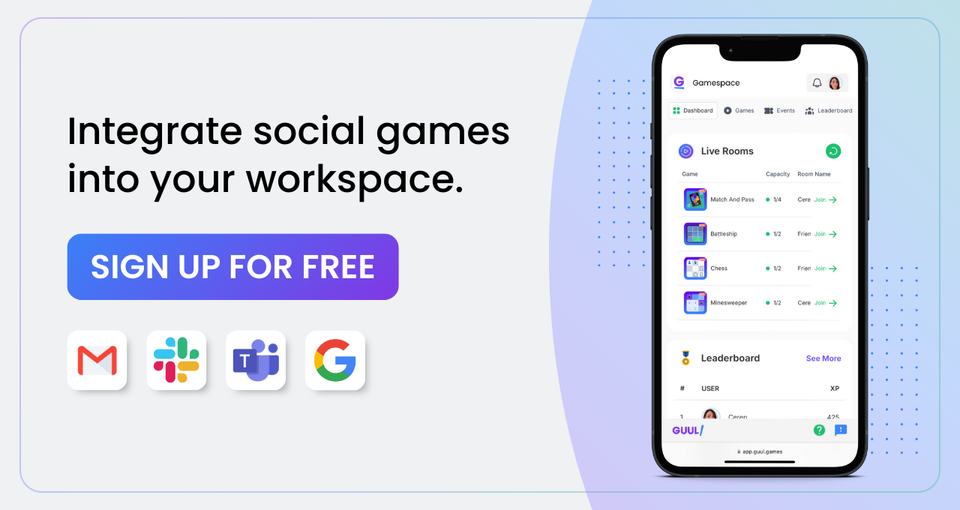
For the competitive formats in this list, GUUL's Gamespace platform provides the infrastructure that makes them sustainable rather than one-time experiments. Daily puzzles reset automatically. Leaderboards update without manual input. Multiplayer games run in real time inside the tools the team already uses.
All competitive formats are available inside Slack and Microsoft Teams, meaning employees join through the platforms they already work in rather than a separate application. For teams that want a fully branded game environment, Gamespace can be configured with custom visuals and scoring logic. Events run on GET, GUUL's credit-based system where each format is priced by type and participant capacity.
Key Takeaways
- Start with a daily puzzle or remote team bingo if your team has low virtual engagement. Both formats require zero preparation and produce immediate visible results that create a reason to return the next day.
- Combine at least one competitive format with one social format across your team building calendar. Competitive activities build habit and visibility; social activities build the relationships that make competitive moments more meaningful.
- Match the activity duration to the time your team realistically has available. A 10-minute activity that happens every week generates more cumulative connection than a 90-minute event that happens once a quarter.
- Use mystery chat or cross-department escape rooms when the goal is connection across team boundaries. Both formats force interaction between employees who would not otherwise have a reason to speak.
- For competitive activities to sustain engagement beyond the first session, they need a visible leaderboard and a reset mechanic. Without both, the motivation to return drops sharply after the initial novelty.
Frequently Asked Questions
What are the best virtual team building activities for remote teams?
The best virtual team building activities depend on what the team needs. For daily engagement, puzzle challenges and quick games work best because they reset regularly and require no scheduling. For scheduled activation moments, live trivia and predictor challenges generate the highest participation. For social connection, mystery chat and virtual escape rooms force interaction between employees who do not normally work together. Most effective programs combine both competitive and social formats.
What are good ice breakers for virtual meetings?
The best ice breakers for virtual meetings are low-barrier activities that produce a visible result within the first five minutes. Remote team bingo works inside an existing meeting without requiring any dedicated time. ELI5 challenge gives each person two minutes to explain something they know. Quick polls with live visible results spark immediate discussion. The common thread is that they require no preparation from participants and generate a shared reaction quickly.
How do you run virtual ice breakers for work without them feeling forced?
Virtual ice breakers feel forced when they require vulnerability or performance from people who have not opted in. The formats that feel most natural are those where participation is low-stakes and the outcome is genuinely funny or interesting. Remote team bingo, ELI5, and quick games all work because the activity is the focus rather than the employee. Keeping the format short, under five minutes for icebreakers at the start of a meeting, also reduces the sense of obligation.
How often should remote teams do virtual team building activities?
A sustainable rhythm combines a recurring lightweight format with a periodic dedicated event. A daily or weekly competitive activity like a puzzle challenge or quick game tournament builds ongoing engagement without requiring dedicated calendar time. A longer social activity, such as a cooking class or talent show, works well once per quarter or around a team milestone. Running too many activities simultaneously dilutes participation; running them too infrequently means the team resets between each one.
How do you measure whether a virtual team building activity worked?
The most reliable signals are participation rate, repeat participation, and spillover conversation. If more than 60% of the team participated, the format was accessible enough. If employees returned without being reminded, the mechanic created intrinsic motivation. If the activity generated conversation in other channels or meetings after it ended, it produced a shared reference point that carried over into how the team interacts. For competitive formats, leaderboard engagement across multiple sessions is the clearest indicator of sustained success.
See how GUUL supports virtual team building for remote teams →