Online team building games: what works and why

Remote and hybrid work has permanently changed the team building problem. In 2024, 60% of managers said it was harder to evaluate and connect with remote employees compared to in-office teams, according to SHRM data. Only 21% of employees globally were engaged, according to Gallup's 2024 State of the Global Workplace report. The gap between the two numbers is, in large part, a connection problem: teams that cannot build genuine relationships do not build genuine engagement.
Online team building games are one of the most practical tools available to HR and people teams for closing this gap, not because they are entertaining, but because they are structurally designed to do exactly what remote work makes difficult: create shared experience, force communication under light pressure, and generate the repeated positive interactions that trust is built from.
Key highlights
- 60% of managers find it harder to connect with remote employees than in-office teams, according to SHRM 2024. Online team building games provide a structured format for the repeated social interaction that remote work environments lack.
- A 2024 systematic literature review published in Scientific Reports, covering research from 2015 to 2024, found that team behavioral interdependence in multiplayer games significantly increases team collaboration and performance, with communication patterns being the primary mediating mechanism.
- Research published in the Journal of Computer-Mediated Communication confirmed that games with high mutual dependence trigger more connectedness, in-game relatedness, interpersonal trust, and cooperative behavior than games with low interdependence.
- A Wiley/Creativity and Innovation Management study (2025) found that game-based practices in remote organizational contexts heighten collaboration by fostering cohesion through game rules and critical thinking through immediate in-game feedback.
- Organizations that promote collaboration are 4.5 times less likely to lose their best employees, according to TeamStage's 2024 research. Online multiplayer games are one of the most accessible levers for building that collaboration culture in distributed teams.
Why remote team building is harder than it looks
The standard remote team building toolkit, a Zoom quiz, a virtual happy hour, a monthly all-hands, has a ceiling. It produces familiarity. It rarely produces trust, and the difference matters.
Familiarity is knowing someone's name and rough job function. Trust is being willing to share an early idea, admit a mistake in front of them, or rely on their work without checking it. The research on what builds trust in teams is consistent: it requires repeated, low-stakes interaction where people observe each other handling uncertainty and pressure. A quarterly Zoom quiz does not produce enough repetitions for this to develop. A game that a team plays together every week does.
53% of remote workers report struggling to connect with coworkers online, according to research cited by Zoe Talent Solutions. The problem is not enthusiasm or intent. It is the absence of a mechanism that creates the right kind of repeated interaction at a workable frequency. Online team building games, when deployed as a regular practice rather than a one-off event, provide that mechanism.
What the research says about multiplayer games and team dynamics
The academic literature on multiplayer games and team behavior has become substantially more rigorous in the last few years, and the findings are relevant well beyond gaming contexts.
A 2024 study published in Scientific Reports (Carrasco-Farré and Hakobjanyan) analyzed team behavioral interdependence and collaboration in massively multiplayer online games across a large player dataset. The study found a direct, nonlinear relationship between interdependence and team performance, with communication patterns emerging as the critical mediating variable. Teams that developed richer communication habits during gameplay showed significantly stronger collaborative outcomes. The parallel to workplace teams operating under pressure is not incidental: the researchers explicitly noted that competitive gaming environments mirror real-world virtual teams working under deadline-driven conditions.
Research published in the Journal of Computer-Mediated Communication established that games with higher mutual dependence, where each player's outcome depends meaningfully on others' actions, produce measurably more interpersonal trust, cooperation, and social capital than lower-dependence formats. This is why format choice matters: a trivia game where everyone answers independently produces a different team dynamic than a cooperative puzzle where success requires coordination.
The 2025 Wiley study on game-based practices in remote organizations added an organizational layer to these findings: games in workplace contexts heighten collaboration by creating cohesion through shared rules and structured feedback, and they build a shared language that informal virtual spaces like chat channels and video calls do not produce as reliably.
What makes an online team building game actually effective
Not every game produces the same team-building outcome. The formats that consistently produce trust, communication improvement, and genuine connection share three structural characteristics.
The first is interdependence. A game where individual performance determines individual outcomes does not generate the trust-building mechanism that cooperation requires. A game where the team's outcome depends on each player's contribution creates the mutual reliance that the JCMC research identifies as the active ingredient. This is why multiplayer word games, collaborative puzzles, and team trivia formats outperform individual leaderboard competitions for team building purposes: the stakes are shared.
The second is repeated play. A single game session produces familiarity. A format that the same team plays weekly produces the repeated interaction cycles that trust development requires. The research on team cohesion across seasons of competition, including the International Journal of Sport and Exercise Psychology findings referenced in the friendly competition literature, consistently shows that cohesion builds through repeated shared experience over time, not through single events.
The third is manageable skill parity. A format that reliably produces winners and losers based on pre-existing skill levels, rather than effort and coordination, creates rather than reduces hierarchy within the team. Games that are accessible regardless of gaming experience, and that reward communication and strategy over technical skill, keep the social dynamic constructive.
Virtual team building activities that work in practice
For HR and people teams designing a game-based team building program, the question is not which game is most fun in isolation but which format produces the team dynamic you are trying to build. This table maps the most effective virtual team building activities to their primary team-building outcome.
| Format | Primary team-building outcome | Session length | Best used for |
|---|---|---|---|
| Multiplayer word game (Scrabble, Boggle) | Communication and light rivalry | 15-30 min | Regular team rituals, cross-functional connection |
| Live trivia (team vs team) | Shared identity, collective achievement | 20-40 min | Onboarding, all-hands warm-up, department events |
| Cooperative puzzle (daily challenge, Nerdle) | Individual habit with shared leaderboard | 5-10 min | Daily async habit, cross-team awareness |
| Tournament (bracket, knockout) | Competitive arc, group identity | Multi-day | Quarterly event, company-wide initiative |
| Prediction game | Collective anticipation, shared outcome moment | 5 min entry, async | Live events, product launches, seasonal moments |
| Team challenge (Battleship, Chess) | Strategic coordination, 1:1 peer bonds | 15-20 min | Pair-based onboarding, manager-direct rapport |
The formats that build the deepest bonds are the ones with shared stakes and a defined outcome moment: team trivia with a leaderboard, tournaments with brackets, prediction games where everyone finds out together. The formats that build the most durable habits are the ones with daily or weekly reset cycles: word games, daily puzzles, and regular team challenges that run alongside work rather than requiring a dedicated event slot.
Team building activities for work: the onboarding case
One of the most underused applications of online team building games in organizational settings is structured onboarding. New employees face a specific social challenge: they need to build relationships with multiple people simultaneously, in a context where they have no shared history, limited informal interaction, and often no natural opportunity to interact with people outside their immediate team.
A multiplayer game session in the first week of onboarding does three things that a welcome call and a Slack introduction do not. It puts the new employee in a position of genuine peer interaction rather than information reception. It creates a shared memory within days of joining. And it provides an excuse for repeated follow-up: "I saw your puzzle score, rematch?" is a conversation that an org chart cannot generate.
For remote and hybrid teams, where the spontaneous hallway conversation that accelerates integration in office environments simply does not exist, a structured game-based onboarding ritual fills exactly this gap. The research on new employee integration consistently points to early peer relationship formation as the strongest predictor of 90-day retention: online team building games are one of the most practical tools for engineering those early relationships at scale.
How GUUL deploys team building games inside Teams and Slack
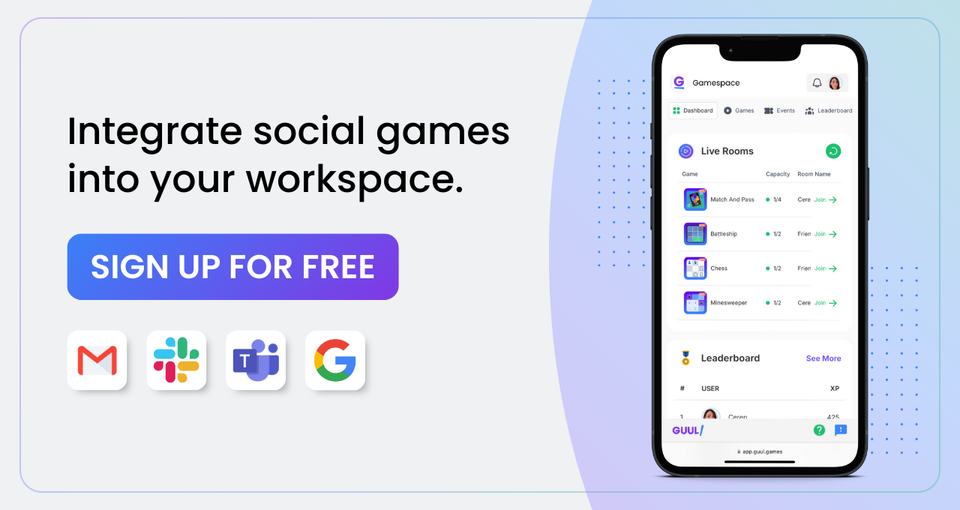
GUUL's integration with Microsoft Teams and Slack means online team building games happen inside the tools teams already use, with no additional download, account creation, or context switch required.
For Teams users, GUUL games run directly inside channels. A team manager can pin the daily puzzle to a shared channel, schedule a weekly trivia session, or set up a department tournament from within the Teams environment. For Slack users, GUUL opens in the web app via a channel link. For Google Workspace teams, sign-in with an existing Google account provides immediate access.
The Gamespace platform provides the full game library: multiplayer classics including Scrabble, Chess, Battleship, and Connect4 for peer-to-peer competition; daily puzzles including Wordle-style word games, Nerdle, and Sudoku for shared leaderboard habits; and live event formats including Trivia, Tombola, and Prediction games for team-wide shared moments.
For HR teams running a structured program, the Gamespace Scheduler manages the event calendar: a weekly trivia session, a monthly tournament, a seasonal prediction challenge, all scheduled in advance and accessible within the collaboration tool. The game layer becomes part of the team's regular rhythm rather than a one-off initiative.
What to measure to know if it is working
Team building outcomes are qualitative by nature but they have quantitative proxies that HR teams can track without expensive surveys.
Participation rate across the team, not just among the most socially active members, shows whether the format is accessible enough to reach the people who need connection most. A team building activity that only the already-engaged participate in has not solved the problem.
Cross-functional participation is the strongest signal for HR teams trying to build organizational connection beyond existing teams. A game format that regularly mixes people across departments, roles, or locations is doing work that almost no other regular activity does.
Manager-to-direct participation in 1:1 game formats, such as paired Chess or Battleship matches, produces a specific relationship outcome: the manager and direct report have a shared competitive history that changes the dynamic in their formal interactions. This is measurable through qualitative 1:1 feedback and quantitatively through engagement survey question clusters around manager relationship quality.
Retention in the 30 to 90 day window for new employees who participated in game-based onboarding versus those who did not is the cleanest ROI signal available for justifying a structured team building games program.
Key takeaways
- Online team building games work because they are structurally designed to produce the repeated, interdependent interaction that trust research identifies as the mechanism behind team cohesion. One-off virtual events do not replicate this effect.
- Format selection should be driven by the team dynamic you are trying to build. High-interdependence formats like team trivia and cooperative puzzles build the deepest trust. Daily puzzle formats with shared leaderboards build the most durable habits.
- Onboarding is one of the highest-value applications for online team building games. Early peer relationship formation is the strongest predictor of 90-day retention, and games are one of the few practical tools for engineering those relationships in remote environments.
- Regularity matters more than production value. A five-minute daily puzzle that a team does every morning builds more cohesion over three months than a highly produced quarterly event.
- Deploying games inside the tools teams already use (Teams, Slack, Google Workspace) is the single most important factor in whether a team building games program becomes a sustainable habit or remains a one-off initiative.
FAQ
What are online team building games and why do they work for remote teams? Online team building games are structured multiplayer formats used to build communication, trust, and cohesion in distributed or hybrid teams. They work because they create repeated, interdependent interaction in a low-stakes context: the conditions that trust research identifies as necessary for genuine relationship formation. Unlike one-off virtual events, recurring game formats produce the multiple interaction cycles that team cohesion requires, and they do so without demanding significant time or coordination from participants.
What virtual team building activities are most effective for remote teams? The most effective virtual team building activities combine interdependence (shared outcomes rather than individual scores), regular repetition (weekly or daily rather than quarterly), and accessible skill parity (formats that reward communication and coordination over gaming expertise). Team trivia, multiplayer word games, and daily puzzle formats with shared leaderboards consistently produce the strongest team-building outcomes. Tournament formats are most effective for creating a company-wide shared moment and cross-functional connections.
How often should a team use online games for team building? The research on team cohesion development points strongly toward regularity over frequency: a five-minute daily puzzle or a weekly 20-minute team game session builds significantly more cohesion over a quarter than a monthly longer event. The goal is to create a recurring interaction ritual that runs alongside work rather than requiring a dedicated event slot. HR teams that have seen the strongest results treat game-based team building as an always-on practice with periodic higher-production moments rather than as an episodic program.
What team building games work best for onboarding new employees? For onboarding, the formats that produce the fastest peer relationship formation are those that create genuine peer interaction rather than information exchange: team trivia in the first week, a paired game (Chess, Battleship) between the new employee and each team member, or a small-group multiplayer session in the first few days. The goal is to produce a shared memory and a reason for follow-up interaction before the formal onboarding schedule runs out. Research consistently identifies early peer relationship formation as the strongest predictor of 90-day retention.
How can HR teams deploy online team building games without adding another tool? The most effective deployment is within the collaboration tools the team already uses. GUUL integrates directly with Microsoft Teams and Slack, meaning games run inside existing channels without requiring a separate download, account creation, or context switch. For Google Workspace teams, sign-in with Google provides immediate access. Embedding games in existing tools removes the adoption friction that causes most team building initiatives to lose participation after the first few sessions.
See how GUUL's team building games work →
Sources
- SHRM (2024). 60% of managers find it harder to connect with remote employees. Cited in Engageli research. https://www.engageli.com/blog/remote-team-building-activities
- Gallup (2024). State of the Global Workplace Report: 21% global employee engagement. https://www.gallup.com/workplace/349484/state-of-the-global-workplace.aspx
- Carrasco-Farré, C. and Hakobjanyan, N. (2024). Experience shapes non-linearities between team behavioral interdependence, team collaboration, and performance in massively multiplayer online games. Scientific Reports, 14, 7850. https://doi.org/10.1038/s41598-024-57919-w
- Depping, A.E. and Mandryk, R.L. / Oxford JCMC (2022). Toxicity and prosocial behaviors in MMOGs: The role of mutual dependence, power, and passion. Journal of Computer-Mediated Communication. https://academic.oup.com/jcmc/article/27/6/zmac017/6700672
- Bernal, I. et al. (2025). Press Start on Collaboration: Game-Based Practices for Fostering Innovative Collaboration in Online Contexts. Creativity and Innovation Management (Wiley). https://onlinelibrary.wiley.com/doi/full/10.1111/caim.12651
- Bisberg, A.J. et al. (2025). Communication Patterns Predict Team Skill in Multiplayer Online Games. Proceedings of ACM CSCW 2025. https://dmitriwilliams.com/wp-content/uploads/2025/10/Bisberg-CSCW-2025-Communication-Patterns.pdf
- TeamStage (2024). Teamwork Statistics: 4.5x retention through effective communication. https://teamstage.io/teamwork-statistics/
- Zoe Talent Solutions (2024). 53% of remote workers struggle to connect with coworkers online. https://zoetalentsolutions.com/virtual-team-building-activities-for-remote-teams/
- Mockflow (2026). Virtual Team Building Games: Gallup engagement data and connection outcomes. https://mockflow.com/blog/virtual-team-building-games